

Dealing with Units
Let’s face it: units and prefixes can be intimidating. But don’t worry, we’re here to make them your best friends. In this chapter, we’ll demystify volts, amps, ohms, and more. By the end, you’ll be converting between milli, micro, and kilo like a pro. Ready? Let’s dive in!
Why Units Matter
Units are the language of electronics. They help us measure and communicate what’s happening in a circuit. Without them, we’d be lost in a sea of numbers. Imagine trying to bake a cake without knowing what a “cup” or “teaspoon” means. Chaos, right?
What You’ll Learn
- The basics of volts, amps, ohms, farads, and henrys.
- Simple tricks for converting between units (e.g., milli to micro, kilo to mega).
- How to use these units in real-world scenarios.
Parts list
- Calculator or multimeter
- Sample capacitors or small parts kit
Hands-On Mini Task
Grab a calculator or multimeter and try this:
- Convert 4700 µF to mF and F. Check your answers using a multimeter if you have one.
Diagram: 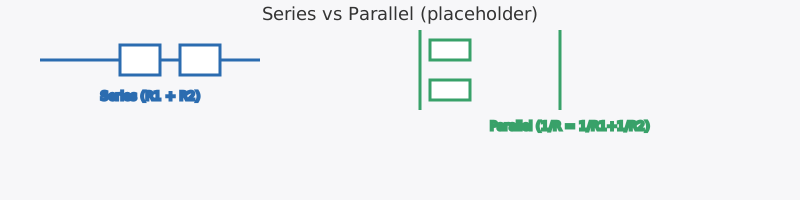
Common Unit Conversions
Here’s a handy table to keep in your back pocket:
| Unit | Symbol | Conversion Example | |-------------|--------|--------------------------| | Volt | V | 1 kV = 1000 V | | Ampere | A | 1 mA = 0.001 A | | Ohm | Ω | 1 kΩ = 1000 Ω | | Farad | F | 1 µF = 0.000001 F | | Henry | H | 1 mH = 0.001 H |
Why It Matters
Electronics uses prefixes all the time. Mastering them saves time, prevents mistakes, and makes you look like a pro. Plus, it’s a great party trick (okay, maybe not, but it’s still cool).
Navigation
- Previous: Introduction
- Next: What Is Electricity