

Learn2026-01-13
Voltage and Resistance
#electronics#voltage#resistance
Voltage and resistance are the dynamic duo of electronics. Voltage is the push, resistance is the brake, and together they control the flow of current. In this chapter, we’ll explore these concepts and show you how to use Ohm’s law to predict and control circuit behaviour. Ready to become a voltage whisperer? Let’s go!
What You’ll Learn
- The meaning of voltage (potential difference) and resistance.
- How to use Ohm’s law (V = I × R) to calculate current, voltage, or resistance.
- Practical examples with LEDs, motors, and more.
Parts list
- 5 V power source (USB power bank or batteries)
- LED and resistor assortment (220–470 Ω)
- Breadboard and jumper wires
- Multimeter
Hands-On Mini Task
Try this:
- Calculate the resistor value needed for an LED with a 5V supply. Then build the circuit and measure the current.
Diagram: 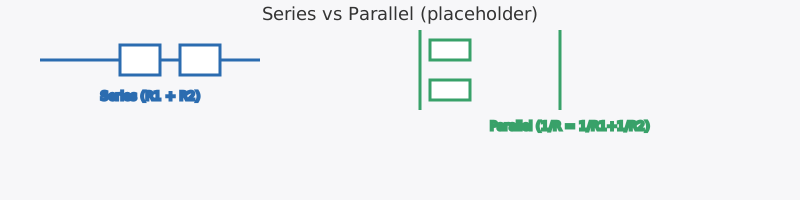
Worked Examples
- Example 1 — LED resistor: 5 V supply, LED forward voltage 2 V, desired current 10 mA (0.01 A). R = (V_supply - V_led) / I = (5 - 2) / 0.01 = 300 Ω. Pick a common value: 330 Ω.
- Example 2 — Current calculation: with a 1 kΩ resistor on a 9 V supply, I = V / R = 9 V / 1000 Ω = 0.009 A = 9 mA.
Real-World Example
Imagine a flashlight circuit: the battery provides the voltage, the bulb offers resistance, and the current flows to light up the bulb. By understanding Ohm’s law, you can predict how bright the bulb will be based on the resistor value.
Troubleshooting Tips
- Problem: The LED is too dim.
- Solution: Use a lower resistor value to increase current.
- Problem: The resistor gets hot.
- Solution: Check the power rating and replace it with a higher wattage resistor.
Navigation
- Previous: What Is Electricity
- Next: Your First Circuit