


Understanding Power
Power in circuits tells you how much energy components convert to heat (or work) over time. The basic formula, P = V × I, helps you calculate how much power a component dissipates; for resistors you can also use P = I^2 × R or P = V^2 / R depending on which quantities are easiest to measure.
What you’ll learn: how to calculate power dissipation, choose resistor wattage, and recognize when a component needs thermal management.
Parts list
- LED, resistor (e.g., 330 Ω), and 5 V supply
- Multimeter
Why it matters: if a resistor or component dissipates more power than its rating, it will get hot and possibly fail. Picking a resistor with an appropriate wattage rating (for example 0.25 W for small carbon film resistors, 0.5 W for many metal film types, and 1 W+ for high-power needs) keeps things safe and reliable.
Hands-On Mini Task: calculate the power dissipated by a resistor in an LED circuit (measure the voltage across the resistor and the current through it), then compare the calculated wattage to the resistor’s rated wattage.
Worked Examples:
Diagram: 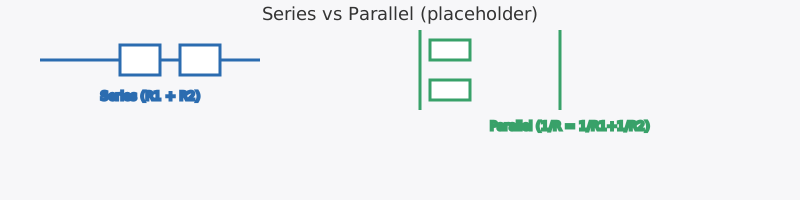
- Example 1 — LED resistor dissipation: 5 V supply, LED forward voltage 2 V, resistor 330 Ω. Current I = (5−2)/330 ≈ 0.00909 A (9.09 mA). Power P = I^2 × R ≈ (0.00909^2) × 330 ≈ 0.027 W, so a 0.25 W resistor is fine.
- Example 2 — High-power case: a device drawing 0.1 A from a 12 V source dissipates P = V × I = 12 × 0.1 = 1.2 W, so use a resistor rated above 1.2 W (e.g., 2 W) or redesign.
Thermal tips: use heat sinks and ventilation for parts that run warm, add decoupling where needed, and always respect maximum power and temperature ratings listed in datasheets.
Safety note: when working with higher voltages or currents, take extra precautions — avoid bare conductors, use proper connectors, and consider fuses or current-limited supplies.
Navigation
- Previous: Basic Resistor Circuit
- Next: Integrated Circuits