

Analysing Series and Parallel Circuits
Series and parallel wiring change how voltage, current, and resistance behave in predictable ways — and learning those patterns makes designing circuits much easier. In a series chain, components share the same current and the voltages split; in parallel branches, each branch sees the same voltage while currents divide according to each branch’s resistance.
What you’ll learn: how resistances combine in series and parallel, how voltages and currents distribute, and simple measurement experiments to verify the rules.
Parts list
- Two identical resistors (e.g., 10 kΩ)
- Breadboard and jumper wires
- Multimeter
- Low-voltage power source (3–9 V)
Practical tip: two identical resistors in series add (R_total = R1 + R2), while two identical resistors in parallel halve the total (R_total = 1 / (1/R1 + 1/R2)). Use series wiring when you want to increase resistance; use parallel when you want the same voltage across multiple branches.
Hands-On Mini Task: build two identical resistors in series, measure total resistance and the voltage across each resistor, then rewire them in parallel and repeat measurements to observe the changes.
Troubleshooting: when measuring resistance with a multimeter, remove power and isolate the component from the circuit if possible. Most measurement errors come from wiring or poor breadboard connections, not the math.
Diagram: 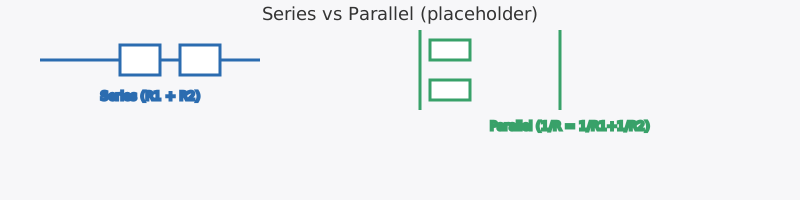
Navigation
- Previous: Constructing and Testing Circuits
- Next: Diodes and How to Use Them