

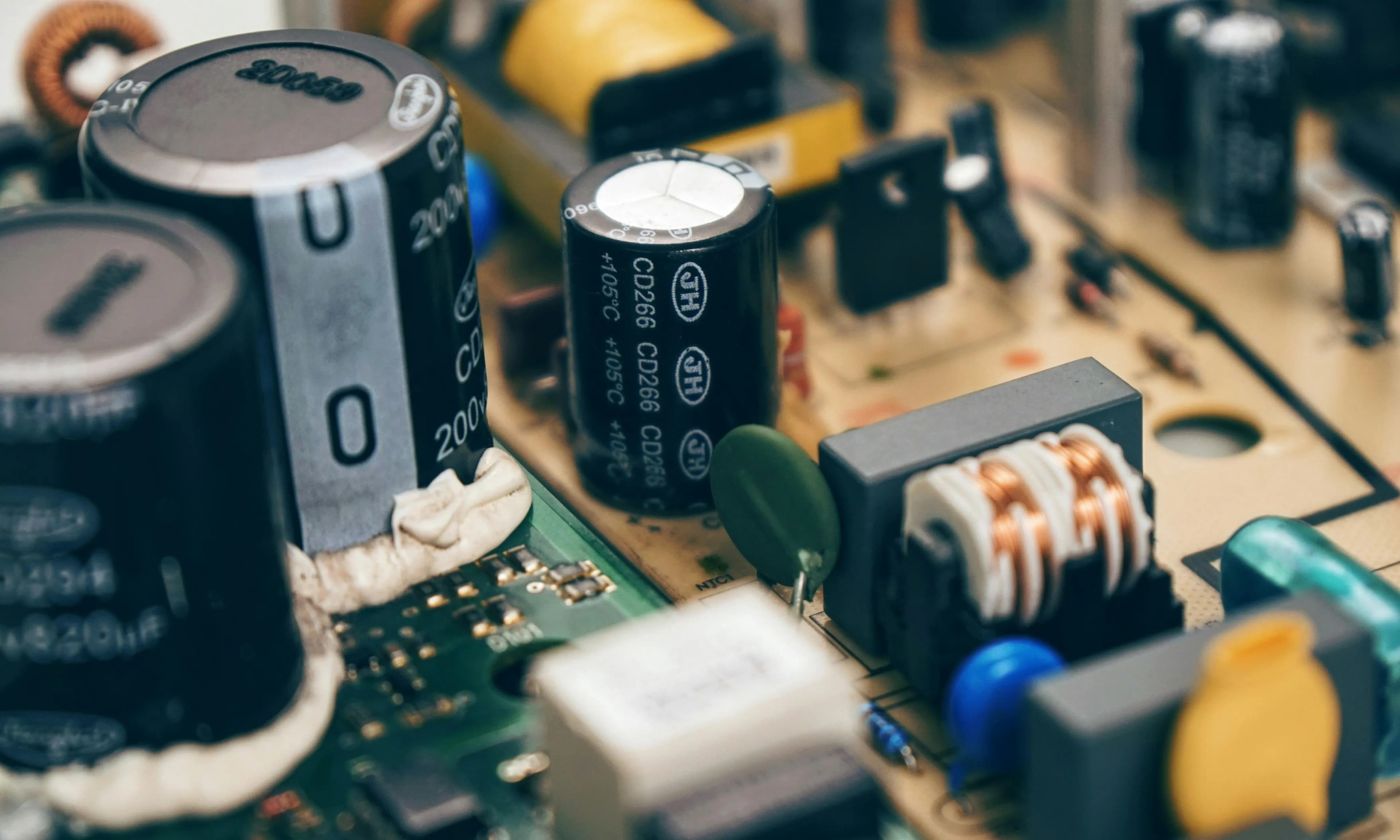
Basic Resistor Circuit
Resistors are the straightforward workhorses of electronics: they limit current, set voltage levels, and stabilize inputs. Use them to protect LEDs, create voltage dividers for sensors, and form pull-ups or pull-downs for button inputs.
What you’ll learn: how to choose resistor values for current limiting, when to use pull-ups/pull-downs, and how to build a simple voltage divider for sensors or level shifting.
Parts list
- Resistors (10 kΩ and 4.7 kΩ recommended)
- Breadboard and jumper wires
- Multimeter
- LED and current-limiting resistor (220–470 Ω)
- Low-voltage power source
A voltage divider is a simple and useful pattern: two resistors in series split an input voltage so the lower resistor’s node becomes a reduced output voltage. Pick values so the divider doesn’t load the source or the input you’re measuring — for sensors, use higher values to avoid wasting power; for stable logic inputs, use lower values to avoid noise.
Hands-On Mini Task: build a voltage divider on a breadboard (for example R1 = 10 kΩ and R2 = 4.7 kΩ), measure the output with a multimeter, then swap values and watch the output change. Also try a current-limiting resistor with an LED and observe how brightness changes as you increase resistance.
Troubleshooting: if readings are off, check for poor connections and ensure you measured across the correct node. Remember that the meter itself can slightly affect very high-value dividers, so lower the resistor values for more accurate measurements.
Practical rule of thumb: for LED current limiting, start around 220–470 Ω for typical 5 V setups; for pull-ups on logic lines, 10 kΩ is a common safe starting point.
Navigation
- Previous: Diodes and How to Use Them
- Next: Understanding Power