

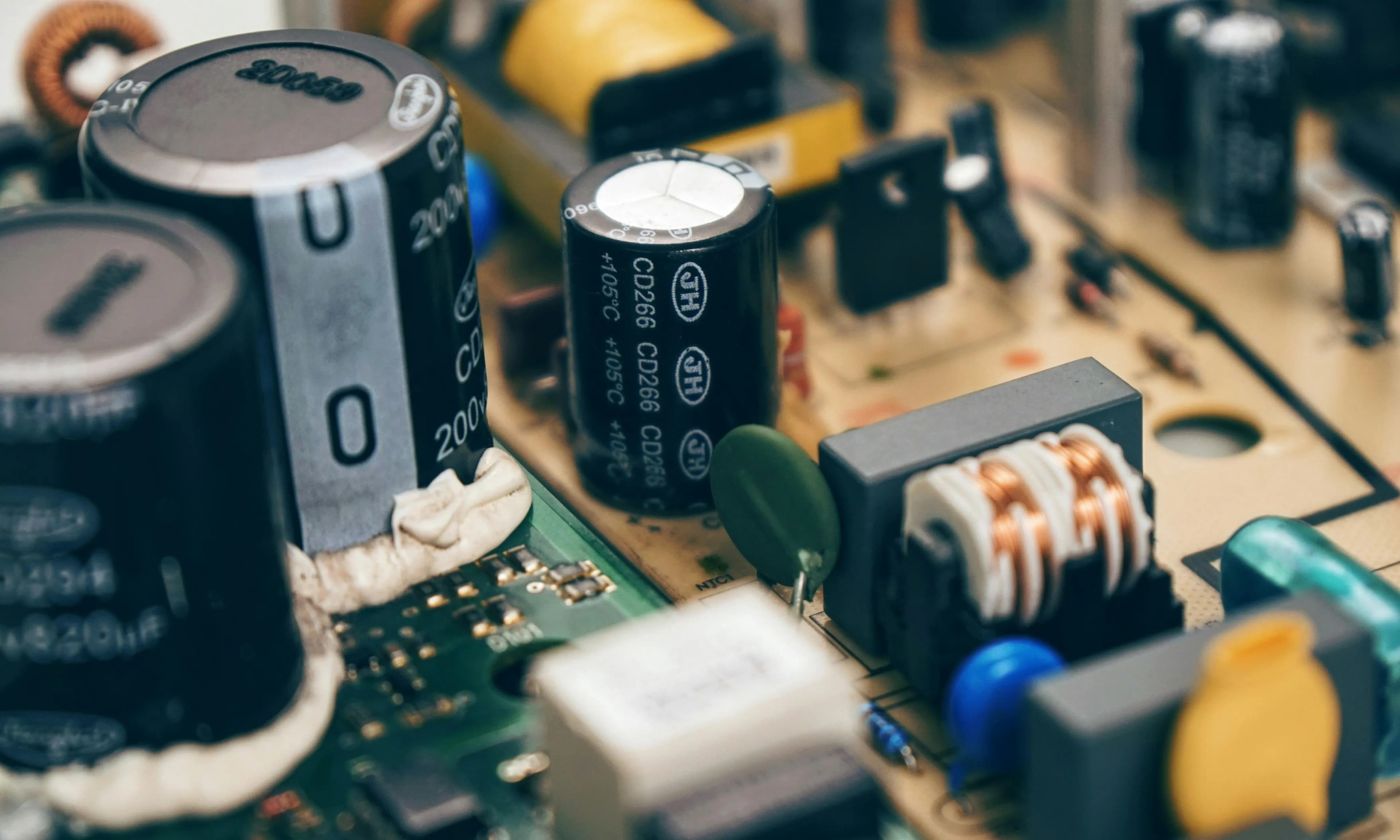
Integrated Circuits
Integrated circuits (ICs) bundle lots of tiny components into a single package so you can add complex behaviour to your projects with just a few pins. Beginners often meet ICs in DIP packages (easy to drop into a breadboard) or surface-mount versions (used on PCBs). The key skill is reading the datasheet: find the pinout, supply voltage range, maximum ratings, and recommended typical connections.
What you’ll learn: how to identify common IC packages, read essential datasheet information (pinout, Vcc, GND, max ratings), and the importance of decoupling capacitors.
Parts list
- DIP IC (e.g., 555 timer or 74HCxx)
- Breadboard and IC socket (optional)
- 0.1 µF decoupling capacitor
- LED and current-limiting resistor
- Power source and multimeter
Start simple: the 555 timer is great for blink and pulse projects, small op-amps like the LM358 help with basic amplification, and 74HC logic chips provide easy gate experiments. Always add a decoupling capacitor (e.g., 0.1 µF) across Vcc and GND near the IC to keep the power rails stable.
Hands-On Mini Task: socket a DIP IC (a 555 or a 74HCxx) into a breadboard, add power and a 0.1 µF decoupling cap, and build a tiny example (e.g., a blinking LED timer). Check the datasheet for the recommended supply voltage and pin functions before wiring.
Diagram: 
Troubleshooting: if the IC does not behave as expected, verify correct orientation (pin 1), supply voltage, and decoupling. If pins are shorted or the IC overheats, remove power and re-check the wiring.
Navigation
- Previous: Understanding Power
- Next: Using Logic ICs