

Learn2026-01-14
Filters and Frequency Response
#electronics#filters#frequency
Why it matters: filters determine what frequencies pass through a circuit — essential for audio, sensors, and signal conditioning.
What you’ll learn: build RC and RL filters, calculate cutoff frequencies, and interpret Bode magnitude and phase plots.
Prerequisites
- Comfortable with Ohm's law and basic circuit concepts from the beginner series
- Familiarity with complex numbers (phasors) is helpful but not mandatory
Learning objectives
- Compute cutoff frequency for simple RC and RL networks
- Sketch and interpret magnitude and phase responses (Bode plots)
- Measure frequency response and compare to theory
Parts list
- Resistors (various values)
- Capacitors (10 nF — 10 µF)
- Inductors (small values for RL examples)
- Function generator or audio source (optional)
- Oscilloscope or sound card + software for measurements
Hands-On Mini Task: assemble a simple RC low-pass, measure the amplitude vs frequency, and sketch the Bode plot.
Diagram: 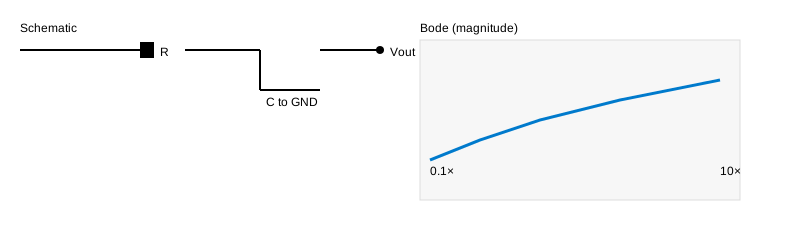
Step-by-step
- Build an RC low-pass: input -> R -> C -> ground, output taken across the capacitor.
- Calculate the theoretical cutoff: f_c = 1 / (2πRC).
- Drive the circuit with a sine source and sweep frequency (audio generator or function generator).
- Measure amplitude at each frequency (scope or sound-card + software) and plot magnitude (dB) vs frequency.
- Compare measured cutoff and slope to the theoretical -20 dB/decade low-pass behaviour.
Worked example
Calculate f_c for R = 1 kΩ and C = 100 nF.
f_c = 1 / (2πRC) = 1 / (2π × 1e3 × 100e-9) ≈ 1.59 kHz.
Expected result
- The measured corner frequency should be within component tolerance of the calculated f_c.
- Magnitude plot should show ~0 dB at low frequencies for a unity-input case, and roll off at ~-20 dB/dec.
Navigation
- Previous: Introduction
- Next: Capacitors and Inductors