

Learn2026-01-14
Capacitors and Inductors
#electronics#reactive#capacitor#inductor
What you’ll learn: impedance, phasors, energy in reactive components, and practical non-ideal behaviour.
Prerequisites
- Basic circuit analysis and comfort with resistor networks
- Familiarity with frequency-domain concepts (see Filters chapter)
Learning objectives
- Calculate impedance of capacitors and inductors in the frequency domain
- Use phasor notation to solve simple AC circuits
- Build and measure LC resonance and observe non-ideal effects
Parts list
- Variety of capacitors (electrolytic and film)
- Small inductors (a few µH to mH)
- Resistors for test circuits
- Multimeter and optional LCR meter
Hands-On Mini Task: build an LC resonant circuit and observe resonance with a function generator or scope.
Diagram: 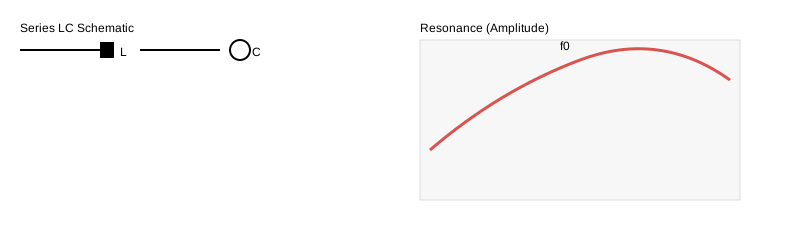
Step-by-step
- Assemble a series or parallel LC circuit with known L and C values.
- Drive the circuit with a swept sine source and monitor amplitude across the relevant component.
- Identify the resonant frequency f0 = 1 / (2π√(LC)).
- Observe bandwidth and note effects of component losses (Q factor).
Worked example
For L = 10 mH and C = 10 nF:
f0 = 1 / (2π√(LC)) = 1 / (2π × √(10e-3 × 10e-9)) ≈ 15.9 kHz.
Expected result
- A peak in amplitude at f0 for series resonance (or a dip for parallel depending on measurement point).
- Resonant sharpness depends on Q; real inductors and capacitors will broaden and shift the peak.
Navigation
- Previous: Filters and Frequency Response
- Next: Transient Analysis