

Learn2026-01-14
Transient Analysis
#electronics#transient#time-domain
What you’ll learn: time constants, solving first-order and simple second-order transient circuits, and practical measurement techniques.
Prerequisites
- Comfortable solving first-order resistor-capacitor and resistor-inductor circuits
- Basic differential equation intuition (we include worked examples)
Learning objectives
- Derive and measure the RC time constant τ = RC
- Solve simple second-order step responses (underdamped/overdamped) qualitatively
- Use an oscilloscope to capture and compare transient responses to theory
Parts list
- Resistors and capacitors for RC circuits
- Inductors for RL examples
- Function generator or pulse source
- Oscilloscope
Hands-On Mini Task: measure the RC time constant and compare to theoretical prediction.
Diagram: 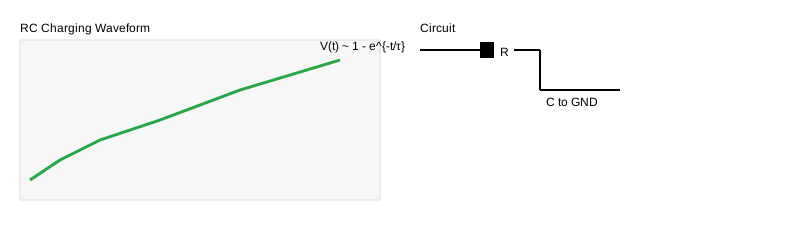
Step-by-step
- Build a simple RC charging circuit: V_in -> R -> C -> ground; measure voltage across C.
- Apply a step (square wave or manual switch) and capture the rising waveform on an oscilloscope.
- Fit an exponential to the rising edge or find the time for the capacitor to reach 63.2% of final value — this is τ = RC.
- Compare the measured τ to the calculated value using component nominal values.
Worked example
For R = 10 kΩ and C = 1 µF:
τ = RC = 10e3 × 1e-6 = 0.01 s = 10 ms.
Expected result
- Measured τ should be close to RC within component tolerances. Deviations may come from source impedance or meter loading.
Navigation
- Previous: Capacitors and Inductors
- Next: Op‑Amps — Small Signal and Applications