

Learn2026-01-14
Op‑Amps — Small Signal and Applications
#electronics#op-amp#analog
What you’ll learn: ideal and real op‑amp models, gain‑bandwidth tradeoffs, and common circuit topologies.
Prerequisites
- Basic circuit analysis and familiarity with passive components
- Exposure to small-signal and frequency-domain concepts (helpful for gain‑bandwidth topics)
Learning objectives
- Understand ideal vs real op‑amp behaviour and common non-ideal parameters
- Build and measure simple inverting and non-inverting amplifier circuits
- Apply op‑amps to active filter and summing applications
Parts list
- General purpose op‑amp (e.g., LM358 or TL072)
- Resistors and capacitors for feedback networks
- Breadboard and power supply (± supply examples optional)
- Oscilloscope
Hands-On Mini Task: build a non‑inverting amplifier and measure gain and bandwidth.
Diagram: 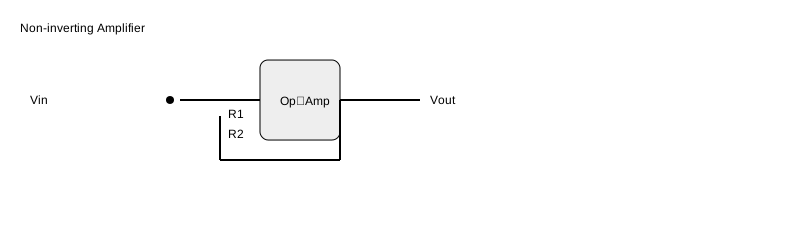
Step-by-step
- Assemble a non‑inverting amplifier: input -> +, feedback network R1/R2 between output and - to set gain = 1 + R2/R1.
- Measure DC gain with a small-signal sine (low frequency) and verify the expected ratio.
- Sweep frequency to find the -3 dB bandwidth and compare to the op‑amp's gain‑bandwidth product.
Worked example
For R1 = 10 kΩ and R2 = 40 kΩ, gain = 1 + R2/R1 = 1 + 40k/10k = 5.
Expected result
- DC gain should match 1 + R2/R1 within resistor tolerances; bandwidth will be limited by the chosen op‑amp.
Navigation
- Previous: Transient Analysis
- Next: back to series index
- Previous: Transient Analysis
- Next: Semiconductor Devices — BJTs and MOSFETs